


As I sit here, on the cusp of turning 39 and seventeen years into my professional career, scrolling through my LinkedIn account reading endless posts centered on adulting at it’s finest, I came across a post not like the others.
Maybe it was the bold yellow color. Maybe it was the simplicity of the headline and design. I was an art history major so a simple, modern aesthetic always catches my eye. Maybe it was because it was claimed to be the Google Work from Home (WFH) Manifesto.
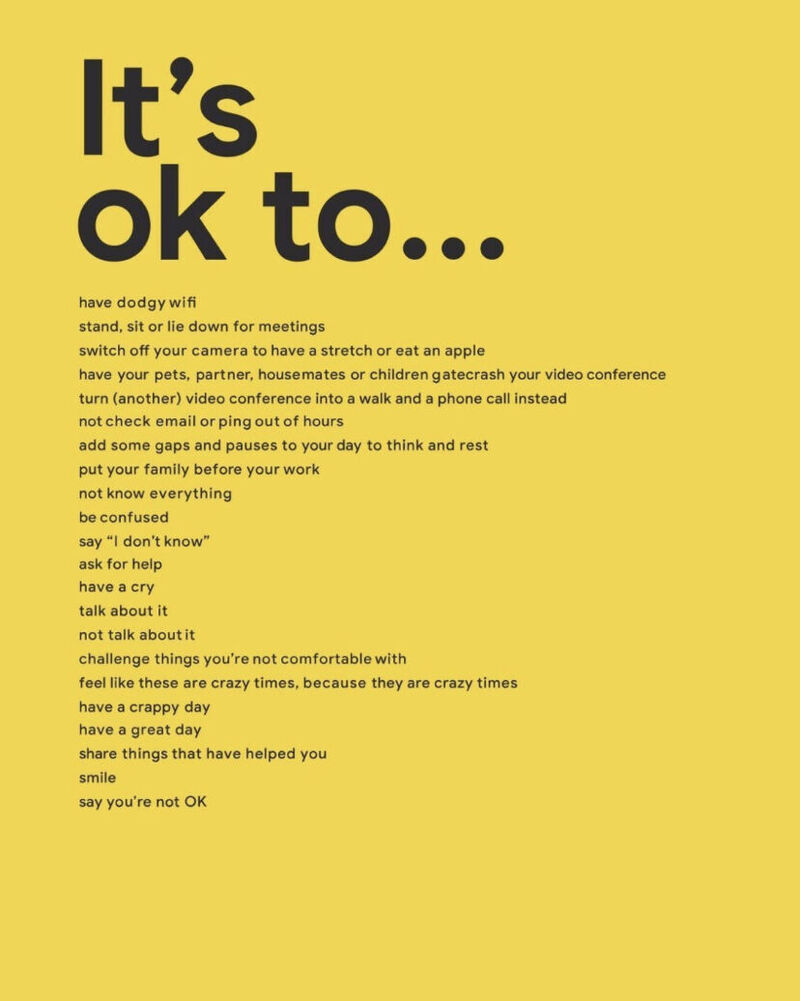
“It’s ok to…
have dodgy wifi
stand, sit or lie down for meetings
switch off your camera to have a stretch or eat an apple
have your pets, partner, housemates or children gatecrash your video conference
turn (another) video conference into a walk and a phone call instead
not check email or ping out of hours
add some gaps and pauses to your day to think and rest
put your family before your work
not know everything
be confused
say “I don’t know”
ask for help
have a cry
talk about it
not talk about it
challenge things you’re not comfortable with
feel like these are crazy times, because they are crazy times
have a crappy day
have a great day
share things that have helped you
smile
say you’re not ok”
All of this is more than ok. It’s totally normal. It’s human.
My platform of choice in that moment, LinkedIn, THE professional networking platform doesn’t heavily circulate “soft” content (my term for the emotionally or mental-health centered stuff). It tends to stick to the basics of networking, job openings, news and announcements and your run of the mill marketing, sales and education. But THIS was different. AND (sorry for all these caps, but I’m making a point here) – AND this post was shared by a LinkedIn Marketing Director/influencer. Why does that matter? (Yep, I’m going to tell you why.) Because Google is a change maker – A. And B – both Google and LinkedIn know that we as humans cannot possibly sustain solely on the hardness of business. We are emotional beings. At the end of the day, we go home – or shut down our laptops – and be with our families and friends. We are allowed to be our true selves again, for just a few hours until we sleep, wake up and activate our work personas once more. It’s like this never-ending cycle of re-programing yourself every morning.
Now you might say, “I’m my true self at work.” Or “I don’t change who I am just for work.” To that, I say “BRAVO!” But I also call Bull Sh**! Do you really talk to your boss, peers or co-workers the same way you do your parents, spouse, siblings, friends or kids? I’m betting not. You’re probably filtering like the rest of us. We all have our “personal brands” to uphold after all. We all want to ensure we might be considered for the next new project or be respected and called upon in meetings and hopefully get that next promotion.
Being on point is exhausting. It’s not how we behave normally, outside of work hours. It’s not normal. It’s not human. It’s an ideal of perfection that doesn’t exist. So, when we fall off point or misstep or are perceived as having come off point or mis-stepped, we beat ourselves up…or someone else beats us up. Of course that’s not a physical beating but it’s truly literal – we have to pick ourselves off the floor and get back up – and that sucks up even more of our mental and emotional energy.
Feel like you’re going head to head with a colleague? Is leadership going down a completely different track than you or the team? Great, now you’ve engaged in a chess game or a political campaign. Suck, suck, suck, suck, suck the life right out! I don’t know about you but I don’t play chess and I f***ing hate politics.
It’s stressful. Its draining. And all we’re trying to do is pay bills and feed our family.
I think our stress and mental burnout is the white collar equivalent to the blue collars’ thrown out backs or blown knees from decades of hard labor – because it does impact us not only emotionally but physically too. See what 7 strange things Cleveland Clinic says can happen to our bodies. No thanks!
Just as hard laborers shouldn’t be run down like work horses until their bodies break down, we shouldn’t have to sacrifice our mental health to make it through our professional office careers.
We need “soft” content.
We need reminders of what’s “Ok”.
We need to give ourselves permission to be human.
Besides, we’re the ones that deprived ourselves of that basic human right anyway.
That’s right – it’s no ones’ fault but your own. I’m at fault for not giving myself permission to do the things on that “OK list”. I really meant it when I said “BRAVO!” if you are your true self at work and home, I want private lessons on how you did it. My anxiety is my barrier and I’m guessing its yours too. Also, I hate to say it but I’m becoming an older dog and need to learn these new tricks that younger generations are adopting. It seems to be the younger ones that understand the importance of mental health better than the rest of us. Maybe they learned from their Gen X parents not to adopt the old school, unhealthy unbalanced approach to life. Unfortunately, my Xennial generation learned from our Baby Boomer parents that the unbalanced approach to work/life is the only way you get ahead. And success in your career determines your success as a human.
So, here I am. Pondering my mid-life/mid-career reset from this LinkedIn post. The honest truth is that I can’t be successful as a mom, a spouse, a sister, a friend unless I allow myself to be a good human first. And those are the priorities I need to settle out in order to add value to my career because that’s the kind of leadership my team deserves too.
I want this to serve not only as my personal reminder, but a reminder to my team at work. And this should be what I start to teach my kids – the next generation.
“It’s ok to…
have dodgy wifi
stand, sit or lie down for meetings
switch off your camera to have a stretch or eat an apple
have your pets, partner, housemates or children gatecrash your video conference
turn (another) video conference into a walk and a phone call instead
not check email or ping out of hours
add some gaps and pauses to your day to think and rest
put your family before your work
not know everything
be confused
say “I don’t know”
ask for help
have a cry
talk about it
not talk about it
challenge things you’re not comfortable with
feel like these are crazy times, because they are crazy times
have a crappy day
have a great day
share things that have helped you
smile
say you’re not ok”

 Midlife Mamacita
1 thought on “Google really does have the answers to life’s questions.”